The weather was looking a little bit iffy on Sunday morning but we headed out to Washington-on-the-Brazos anyway and hoped for the best. Washington-on-the-Brazos is a Texas State Park but there is no entrance fee to walk the grounds where Texas had it's beginnings.
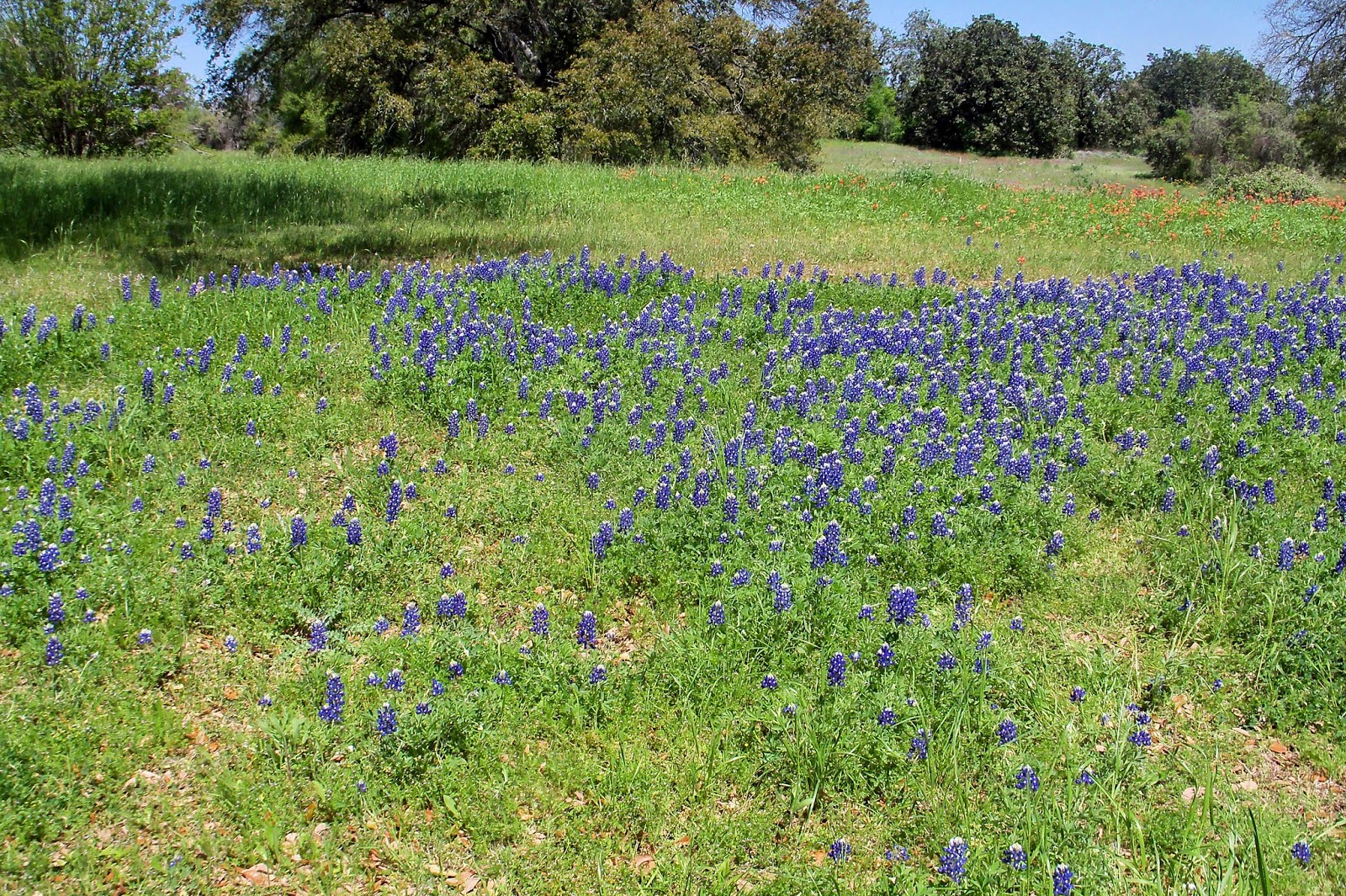
There were wildflowers as we walked the paths. There is a field where they were supposed to be beautiful but the ranger told some other people that it was really muddy on the trail leading out to them so we had to pass.
While the battle at the Alamo was being fought, delegates from all over Texas made their way to Washington-on-the-Brazos for the March 1836 Convention. At great personal risk to themselves and their families, they signed the declaration creating the Republic of Texas. Today all the buildings except Independence Hall are gone but you can see pillars where other buildings stood and there are numerous displays telling about this small town that birthed the Republic.
This is Independence Hall. It is all set up inside just like it would have been when the delegates met to debate whether they should continue under Mexican rule or vote for a new nation. It was nothing fancy and this was a pretty small town.
This native pecan tree was alive back when the Republic of Texas was born! Every day the rangers harvest the pecans and start them as new pecan trees. How neat is that??
Andrew Robinson was a pretty big man in town. He owned and operated the ferry as well as several other buildings in town.
This is the bluff overlooking the original ferry landing.
Back in the main building, there is a lot of information about this historic site and it's wise to look at it all before you follow the paths around the town. There is also a ranger led tour but it was a little later and we didn't want to take a chance on being rained out. They also have a nice gift shop.
Our next stop was the Star of the Republic Museum right there on the grounds. This is a two story museum with lots to see including a movie. There is a charge for the museum as it is not run by the park but it is worth the admission price.
There is also a living history farm which is also interesting. I have been there before but we passed on it today because of the threatening rain and the rain we had earlier.
Next stop, lunch in Navasota at Martha's Bloomers . It's a Garden Shop and Tea Room.
This interesting plant was out front and it wasn't grapes.
The Tea Room is fantastic! The staff is great ushering you to tables with white linen cloths and napkins. Then they bring you demitasse cups of Orange Spice Tea and samples of scones while you look at the menu. The food was both delicious and reasonable. Some of us had quiche and tomato bisque soup. Others had a sampler salad that was beautiful and huge. We were all too full for dessert.
We strolled around the garden shop. Several of us had to buy some of the house Orange Spice Tea.
Later on back at the RV park, we all enjoyed Happy Hour in the Rally Room and snacked on some of the leftovers from the potluck for dinner.
The Longdogs
Gretchen, Willy, and Harley have all taken their roles as navigator seriously! Now it's Xena's turn with guidance from her role models.
Pages
Showing posts with label Washington On The Brazos. Show all posts
Barrington's Living History Farm
There is a lot to see here at Washington-on-the-Brazos and our next stop was Barrington Living History Farm.
Dr. Anson Jones was the owner of Barrington Farm named after his native town in Massachusetts. He was also active in the Republic of Texas as a doctor, congressmen, minister to the U.S., senator, secretary of state, and served as the final president of the Republic before it became the 28th state of the Union in 1845. He was married to Mary Smith McCrory in 1840 and moved to Barrington Farm after his inauguration with his wife Mary, their 4 children, his sister, Mary's four half-sisters, and the slaves.
The home is the original structure built in 1844 and moved to the Historic Site in 1036. The outbuildings were recreated from typical Texas architecture of the times as well as noted in Dr. Anson's journals.
There were two costumed interpreters, one in the house and one in the barn. The bed is stuffed with cornstalks and very lumpy.
The dining room was probably used mostly in the cold months with the family eating outside while it was warm.
The second bedroom was for Dr. Anson' sister who also taught the children their lessons.
The children, except for the two youngest who slept in their parent's room, slept in dormitories upstairs which were reached by some very steep stairs.
The parlor was the most formal room in the house used for company, as a library, and as an office.
The kitchen where all the food was cooked by the cook, was detached from the house both to keep the house cooler and as a safety measure. The cook had to carry everything in to the house.
The interpreters actually fix a meal in here on the weekends and can attest to the fact that it is uncomfortably hot in the summer.
The smokehouse was used both to smoke the meat and to store other food items during the rest of the year.
There was a chicken coop and some very large chickens as well.
This was known as a double crib barn and has an open area between the two buildings just like the house.
There was also another chicken pen at the rear of the barn.
This was one of two slave cabins with the hog pen in the background.
It was a one room cabin which included sleeping quarters as well as eating and cooking areas.
We headed back down the highway and across Lake Conroe late in the afternoon.
This was my last day with Deb but she will be staying in the area another week.
Dr. Anson Jones was the owner of Barrington Farm named after his native town in Massachusetts. He was also active in the Republic of Texas as a doctor, congressmen, minister to the U.S., senator, secretary of state, and served as the final president of the Republic before it became the 28th state of the Union in 1845. He was married to Mary Smith McCrory in 1840 and moved to Barrington Farm after his inauguration with his wife Mary, their 4 children, his sister, Mary's four half-sisters, and the slaves.
The home is the original structure built in 1844 and moved to the Historic Site in 1036. The outbuildings were recreated from typical Texas architecture of the times as well as noted in Dr. Anson's journals.
There were two costumed interpreters, one in the house and one in the barn. The bed is stuffed with cornstalks and very lumpy.
The dining room was probably used mostly in the cold months with the family eating outside while it was warm.
The second bedroom was for Dr. Anson' sister who also taught the children their lessons.
The children, except for the two youngest who slept in their parent's room, slept in dormitories upstairs which were reached by some very steep stairs.
The parlor was the most formal room in the house used for company, as a library, and as an office.
The kitchen where all the food was cooked by the cook, was detached from the house both to keep the house cooler and as a safety measure. The cook had to carry everything in to the house.
The interpreters actually fix a meal in here on the weekends and can attest to the fact that it is uncomfortably hot in the summer.
The smokehouse was used both to smoke the meat and to store other food items during the rest of the year.
There was a chicken coop and some very large chickens as well.
This was known as a double crib barn and has an open area between the two buildings just like the house.
There was also another chicken pen at the rear of the barn.
This was one of two slave cabins with the hog pen in the background.
It was a one room cabin which included sleeping quarters as well as eating and cooking areas.
We headed back down the highway and across Lake Conroe late in the afternoon.
This was my last day with Deb but she will be staying in the area another week.
Washington on the Brazos
Wednesday found us on the road again headed to Washington-on-the-Brazos State Historical Site. It was a very pretty drive. First we had to cross Lake Conroe and cut across country. Hmmmm, maybe we should have cleaned the windshield first.
The weather was great, the scenery was beautiful.
I wonder what's behind this gate. It sure is pretty out front.
About an hour later we arrived at Washington-on-the Brazos State Historical Site.
History always seems so much more real when you can make it come alive. Washington-on-the-Brazos is the birthplace of Texas. Not the state of Texas but the Republic of Texas.
We strolled out of the visitor's center and headed to Independence Hall.
The town of Washington-on-the-Brazos came to life in 1834. War within Mexico was building. Texas was part of Mexico and the citizen's of the area, immigrants from the U.S. as well as native Texanos were increasingly dismayed by what was happening. In 1835, enterprising citizens promoted the town as the site of a convention offering their town meeting hall to discuss formation of an Independent Republic of Texas.
This is where it all began. Fifty-nine individuals, mostly under 40 years old, attended the convention in 1836 including several native Texans, a Mexican, and others from the United States and Europe.
Sam Houston was selected at commander of the revolutionary army and left to gather forces at Gonzales. The Constitution was patterned after that of the United States and several southern states. When news arrived that the Alamo had fallen, the Constitution was hastily signed.
David Burnett was the interim President. Negotiations began to reach peace with Mexico. Sam Houston was elected as the first President in September. Such an important place in Texas history and this is what remains of the rest of the town.
There are placards providing information about the original townsite bringing it back alive with imagination.
Down below this bluff is where the ferry was located. Andrew Robinson was a very enterprising businessman operating the ferry as well as several other businesses in the town.
There are lots of trees in the area but The La Bahia Pecan has special significance as it was present back when all the history was happening.
I couldn't get a very good picture of it. It's very tall. You can just barely see it budding out.
Along the path further is an amphitheater.
In the distance you can see a very nice picnic area and playground for visitors.
The Republic of Texas lasted for 10 years. On 19 February 1846, Texas became a state under the United States.
Next we headed into the Star of the Republic Museum.
Remember Andrew Robinson....he was an important man.
First we saw a movie which outlined important events and culture. Then we began looking at the exhibits.
There is quite a bit to look at ranging from history to culture with some great displays. It is laid out in an easy to follow pattern. Our final stop was a living history farm but I gave that it's own post.
Subscribe to:
Posts (Atom)